theMilesWeKeep
Somewhere Between Airports and Ancient Wonders
May 13, 2026
There’s something wildly humbling about standing on one of the most iconic landmarks in the world before most people have even had their first cup of coffee.
Our journey to the Great Wall of China started at 3:45am, wheels down in Beijing after a long-haul flight and just enough sleep to function. This wasn’t a full China trip. It was a layover; the kind most people use to find an airport lounge and survive. But somewhere between booking flights and convincing ourselves we could absolutely make this happen, a long layover became an opportunity to stand on one of the Seven Wonders of the World.
And honestly? It was one of the best decisions we made all year.

We had arranged a private tour ahead of time, and our driver was waiting when we landed. Thank goodness, because navigating the airport at that hour while half-awake felt like a fever dream. One important thing to know: travelers with a U.S. passport (and several others) can enter China for up to 10 days without a visa under the transit policy. Sounds simple in theory. In reality, the line situation can feel like a competitive sport.
We learned that the hard way.
After standing in multiple — and apparently incorrect — lines, we finally found the right process. Somewhere between exhaustion and confusion, we both quietly wondered if paying for the visa ahead of time might have been worth it just to avoid the maze of entry checkpoints and treacherous lines. Consider this your warning from two travelers who figured it out in real time.
Once we escaped the airport, Beijing slowly started waking up around us as we made the drive to the Mutianyu section of the Great Wall. We intentionally chose Mutianyu because it’s known for being less crowded than some of the more tourist-heavy sections like Badaling, especially if you arrive early. That decision paid off immediately.
The morning fog still hung low over the mountains when we arrived. Quiet pathways. Cool air. Barely any crowds. It felt less like a tourist attraction and more like stumbling into something ancient and sacred before the rest of the world showed up.
And then came the ski lift.
Yes, a ski lift.
There’s something hilarious about taking a ski lift to one of the oldest architectural feats in human history, but honestly, it was one of my favorite parts. Suspended over the trees as the Wall slowly revealed itself along the mountain ridges felt surreal. Like watching history appear out of the clouds.
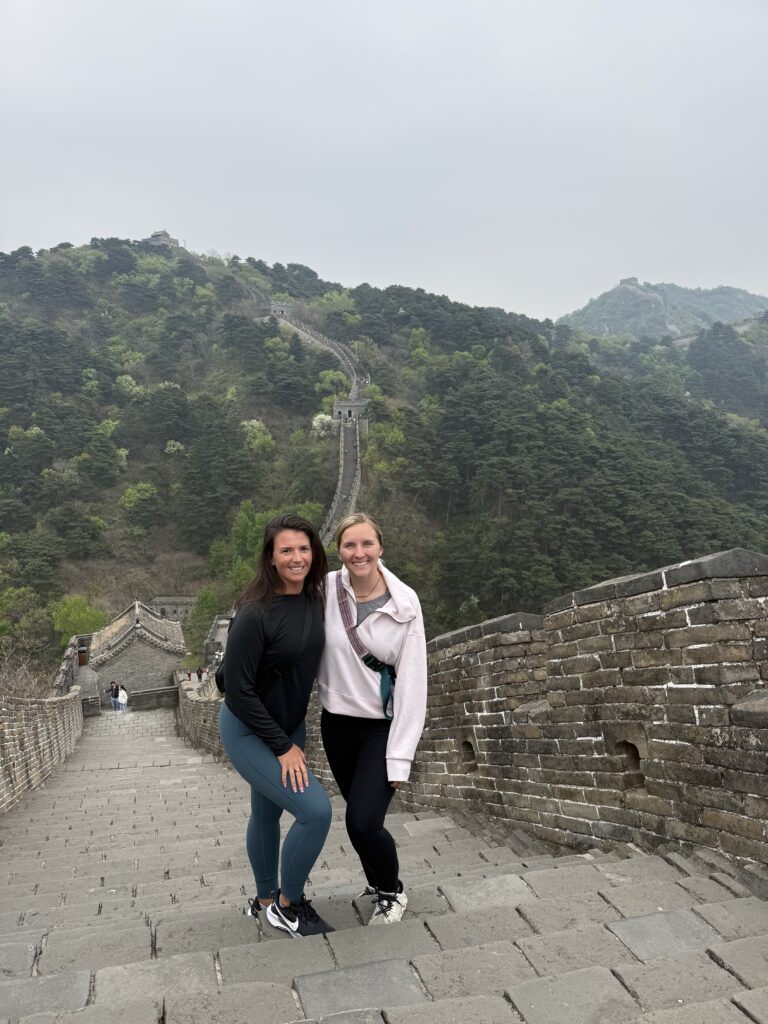
But let me clarify something quickly for anyone imagining a casual stroll along the Great Wall: walking the Great Wall is not a walk.
It is a hike.
A climb.
At times, a crawl.
The South section especially had us WORKING. Some stretches were steep enough to make your calves question every life choice you’ve ever made. Uneven stone steps varied wildly in height, and certain inclines felt more like climbing a ladder than walking a path. There were moments we were bent forward, hands on thighs, laughing through heavy breathing while trying to pretend we weren’t completely gassed.
And somehow, that’s what made it unforgettable.
The Wall twists endlessly over the mountains in a way photos never fully capture. It’s massive, yes — but more than that, it feels alive. Weathered stones beneath your feet. Watchtowers standing stubbornly against time. Silence interrupted only by footsteps and wind moving through the hills.
You don’t just see the Great Wall. You experience it physically.
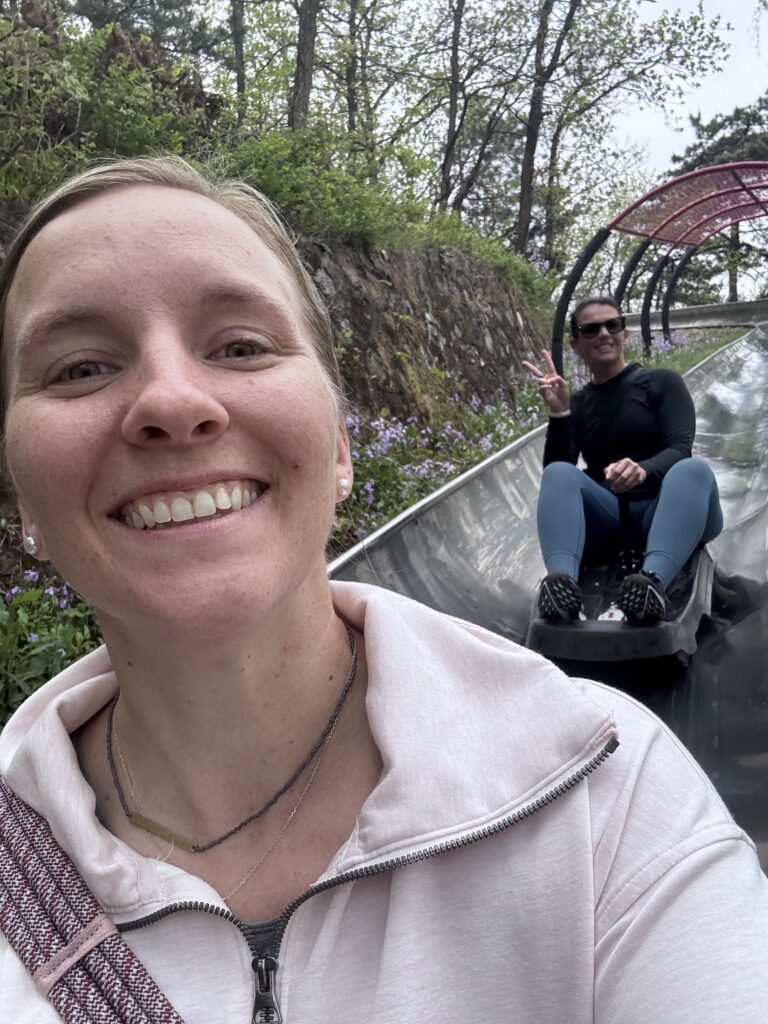
And after earning every single one of those views, we rewarded ourselves with the most unexpectedly fun descent imaginable: the alpine slide.
Imagine a hand-powered sled on a metal track winding down the mountain like a slalom course. Equal parts thrilling and mildly chaotic. One minute you’re taking in mountain views, the next you’re aggressively pulling the brake because the person in front of you has decided to crawl downhill at grandma speeds. It was ridiculous and joyful and exactly the kind of travel memory that sticks forever.
There’s something magical about squeezing a once-in-a-lifetime experience into the margins of a trip. About refusing to treat a layover like lost time.
Most people think extraordinary travel requires weeks of planning and endless vacation days. But sometimes it looks like landing at 3:45am, surviving immigration confusion, climbing ancient stone steps on two hours of sleep, and racing down a mountain on a tiny sled before heading back to the airport.
And somehow, that makes it even better.
Leave a Reply
X
X


Add a comment
0 Comments